The cloud behind your eyes: Android XR and the camera stream
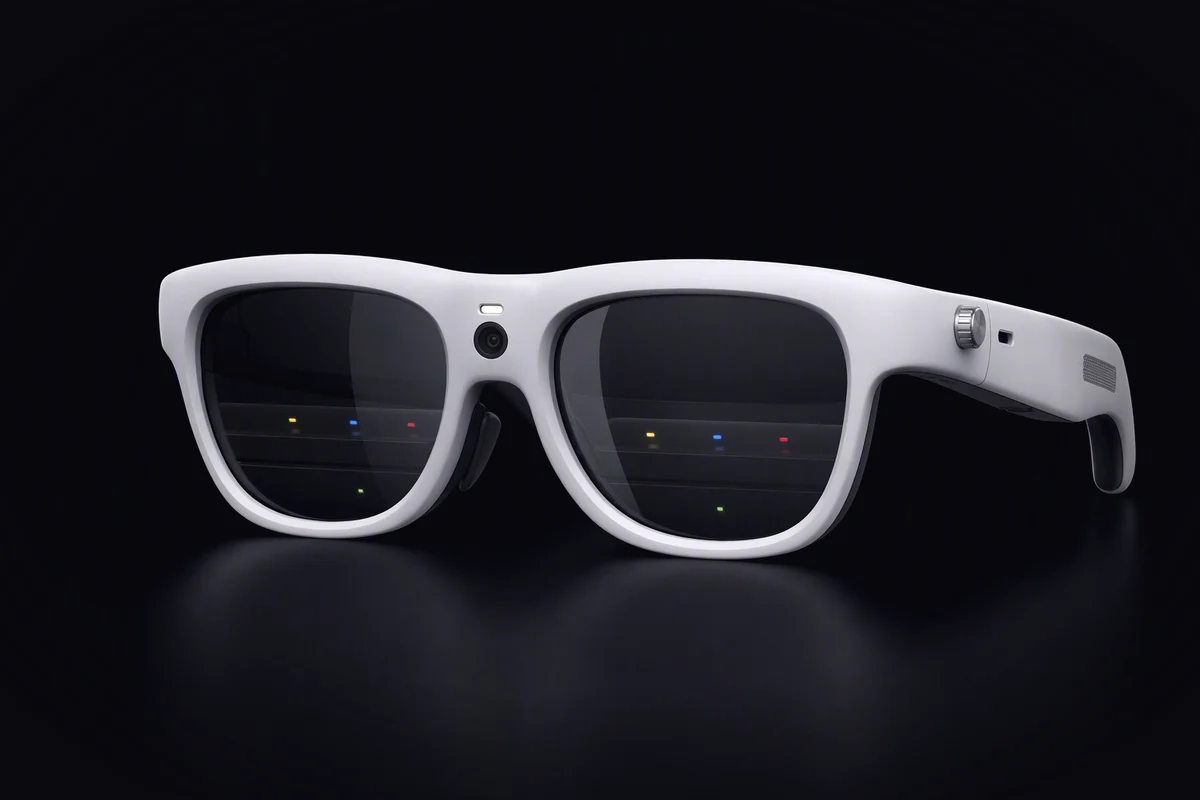
A colleague walks into a meeting room wearing glasses with a small light on the bridge. Halfway through, she asks her assistant to remember the whiteboard. Nobody else in the room was asked anything. The whiteboard, the faces in front of it and the printout on the table are now part of a request, and the request went somewhere.
This is about to become ordinary. Android XR is Google’s platform for headsets, glasses with a display and audio glasses, built with Samsung and Qualcomm, with Gemini as the assistant layer. The first device was Samsung’s Galaxy XR headset in October 2025. At Google I/O in May 2026 Google showed glasses with frames from Warby Parker and Gentle Monster; audio glasses work with the phone, Android or iOS, and Gemini carries out multi-step tasks on the phone in the background, with the glasses as its voice and camera. Samsung has announced its own Gemini glasses for November 2026, and XREAL Aura is the first priced pair of display glasses on the platform. Counterpoint, as quoted by Android Authority, counted shipments of smart glasses up 263% year on year in the first half of 2026, with 96% of them glasses without a display. The cameras are arriving faster than the screens.
The real cause: eyes, assistant and cloud from one provider
What has changed is not the camera. Phones have had cameras for twenty years. What has changed is that the camera is always at eye level, that the assistant reading it is part of the system, and that the system, the assistant, the store and the cloud behind them come from one provider. How much of the assistant’s work happens on the glasses, on the phone or in the cloud has not been published, and we will not guess. But whichever cloud it is, it is not one you chose separately from the glasses.
What goes wrong when the cloud sits behind your eyes
A frame is not a query. A typed question contains what you meant to ask. A frame contains everything you were looking at: screens, documents, faces, the room. Whatever is sent is sent whole, unless something on the device decided otherwise.
Bystanders did not agree. A privacy light tells the people around you that a camera is on. It does not tell them where the picture goes, how long it is kept or who can see it. They have no settings page.
Retention is a policy, not an architecture. A provider can promise to keep frames briefly, and may mean it. The promise holds as long as the policy does, and policies change with products, owners and countries.
Jurisdiction follows the data. For a European company, the question of which country’s law applies to a frame of its meeting room is not abstract. EU data rules expect you to know where personal data goes and on what grounds. A camera stream to an unspecified cloud makes that hard to answer.
One provider for everything. When the glasses, the system, the assistant, the store and the cloud are one company’s, leaving any of them means leaving all of them. That is the quiet cost of a platform that works well.
What a sovereign cloud should do instead
KyberFusion is built as the network layer of the Kyber ecosystem: a cloud for SI work that is designed to see work, not a person, and that does not live on data. There is no advertising and no data sale anywhere in the ecosystem, which is why who pays for the cloud has a different answer here.
The frame stays with you by default. The assistant decides what a task needs and keeps the rest on your device or your home node. When the trust side of that decision matters, it asks first, which is the subject of KyberBot on Android XR.
What leaves is sealed and minimal. A task goes out as a KyberCell with a crop, not a room, and a node sees a class of work and a time budget rather than an identity. The full list is in what a cloud node knows about you.
The record comes home. Every step is logged as a trajectory that travels back with the result, so you can show where a frame went, rather than trust a policy that says where it did not.
Separable layers. Your device, your system, your assistant and the cloud that lends it power should be replaceable one at a time. Whose system rules the body is the question KyberDeck asks, and why a Linux kernel under Android XR does not settle it is explained on KyberLinux.
Kyber does not integrate with Android XR, and we do not suggest it does. This is how we think about the same problem in a system built from the other end.
The honest limits
KyberFusion is pre-launch, there is no network to join, and “anonymous” is a goal, not a claim. A sovereign cloud does not solve the bystander problem on its own: a frame kept on your own node is still a frame of someone who did not agree. The only full answer to that is not taking it. And Android XR has a working SDK, an emulator and announced hardware; we have a design. And the first priced display glasses on the platform do not ship to Poland or the rest of the EU in their first wave.
A test you can run today
Open the activity or history settings of the assistant on your phone, the one most likely to run behind your future glasses. Find out three things and write them down:
- Are images and voice recordings kept, and for how long by default?
- Can you see them, one by one, and delete them?
- Is there a setting that keeps them off the provider’s servers entirely, and what stops working if you turn it on?
Then think of the last room you were in with other people, and ask whether you could answer the same three questions on their behalf. If not, that is the gap a cloud behind your eyes opens. The KyberFusion homepage describes the network we are building to close it.
- Android XR
- Gemini
- glasses
- sovereign cloud
- privacy